Monday, January 30, 2012

Enter our Cabin Naming Contest and Win a Free Stay

Four new campground cabins will be ready for use in Woodford State Park starting this spring, but right now two of them are nameless. So, we're having a cabin naming contest!

The cabins have to be named after native Vermont flowers. So, all you have to do is tell us which flowers we should choose and why! The other two have already been named Gentian and Trillium so all other flower names are available.

Send your entry to: parks@state.vt.us with "Cabin naming contest" in the subject. In the email include your name, address, and your names and explanations by March 1, 2012. You can also mail entries to us at 103 South Main Street, 10 South, Waterbury, VT 05671.

The lucky winners will be announced mid-March. As their prize, they will able to stay for two nights in their named cabin, and we’ll also post a framed write up and photo in the cabin all season!

You can make history and decide what these cabins should be called – forever! Good luck and let the "Names" begin!

For more information visit www.vtstateparks.com or call 1-888-409-7579.

Bookmark and Share

Thursday, January 26, 2012

Red Throated (no, make that a Common Loon) Rescue at Sand Bar State Park!

Bob Dill shared a first hand account of a unique sighting (and rescue) yesterday through Vermont Birds Listserv. We'd like to share his tale:

Bill and a friend, named Phelps, were ice skating off Sand Bar State Park yesterday and soon spotted a distressed red-throated loon on the ice of Lake Champlain. The ice was inhibiting the bird from taking off; it was too slippery. They came ashore for advice and more equipment.

After several calls, they finally got a hold of Carol Winfield in Westford who walked them through how to capture, transport, and release the loon safely. The two men borrowed an extra car coat from a neighbor of Phelps' who happened by at just the right time and skated back out to the bird. Luckily, the capture was straight forward and went off smoothly. The loon was walked back in rather than skating to reduce the risk of falling with the bird.

Bill and Phelps took a short drive to a bridge where rocks near the bridge were free of ice, allowing easy access to ice free water. Bill was able to place the bird near the waters edge, remove the coat, and give it a little nudge. The loon dove into the water immediately and repeatedly. Success!

Bill plans on checking tomorrow to verify that it has moved on. It was his first and, he is sure, closest encounter with a red throated loon. Click here to see pictures of the bird and a short video of the capture.

Bookmark and Share

Update: Bridget Butler and a lot of folks were talking about and reviewing photos over the weekend and now the consensus is that this is a Common Loon, not a Red Throated Loon.

Friday, January 20, 2012

A Question Asked and Answered: Some Really Interesting Camel's Hump History

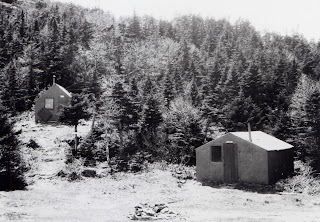
Tin huts on Camel's Hump clearing
We get questions of all kinds in our reservation call center, many relating to the history of certain land parcels. We're always amazed by what we learn, and thought you might be interested in this one:

A person wrote to us about the restoration of Camel's Hump as follows: "I came across some old photos of tin huts on the upper portion of the mountain that were used by hikers and, I guess, maintained by the GMC back in the 1920's and 1930's. I understand that those intrusions have since been removed and wonder if you can tell me when this laudable action took place?"

Gary Sawyer, Stewardship Forester for the Vermont Department of Forests, Parks & Recreation is my go-to guy for all things Camel's Hump. He knows everything about 'The Hump'. He sent some photos and this reply:
Camel's Hump hotel

During the mid to late 1800’s, into the early 1900’s, it was quite popular for folks from ‘down-country’ to travel on a train ‘up-country’ for a ‘wilderness’ experience. One of the destination locations was Camel’s Hump. The train would stop at the North Duxbury depot, from where visitors would take a horse drawn carriage part way up the mountain, resume their trek on horseback much of the rest of the way, and ‘hike’ the remaining short distance from the now called hut clearing.

Camel's Hump Club hut
This hut clearing is located at the present junction of the Monroe, Burrows, and Long Trails, about 0.3 miles below the summit. This clearing was probably the location of the Green Mountain House, a hotel built by Sam Ridley and sons in 1859 for the travelers, photo attached. This structure burned down in 1875.

The Camel’s Hump Club, a Waterbury based hiking group (not the Green Mountain Club), starting in 1908, used the hut clearing for 4 tents, which were replaced with 3 huts in 1912, photos attached. These huts were removed in the 1950’s. There was also an observation building built on the very summit of the mountain, photo attached.

By the way, this land (a 1,000 acre parcel, including the hut clearing) was donated to the State of Vermont by Col. Joseph Battell in 1911.

Camel's Hump observatory


Bookmark and Share

Thursday, January 5, 2012

A Loon Rescue, a Bird Attack, and Rare Spottings

The loon rescue using the new airboat
Loon enthusiast and VT State Parks Program Host, Eric Hanson, took part in an exciting loon rescue just before the new year. Eric posted the following story on his blog for Vermont Center for Ecostudies:

A wounded loon could not take flight from his home in Lake Eligo, (Greensboro, VT) when it began to freeze over. This little bird endured a week of less and less open water while fending off bald eagle attacks until his hole finally froze over completely.

Vermont Fish and Wildlife Dept. Game Warden, Russ Shopland, came to the rescue using a newly acquired airboat to scoop up the injured loon. (the rescue team took this opportunity to do a practice run of a thin ice rescue)

The loon during recovery
in Eric's bathtub
After the rescue, Eric nursed the loon in his bathtub, feeding him minnows while his wing was healing and sent us the following update:

The loon had an old break in his wing as an x-ray from Lamoille Valley Vets showed, but the bone was still a bit out of alignment. The loon could fly but only for short bursts, and was fine in the water. He easily could live out his life as long as he didn't have to fly. The ocean was where he needed to be. Eric called some folks who offered to drive the loon to the coast and added that it would be part of their New Year's celebration. They delivered this loon along with a second one (who had crash landed on a road in Morrisville the morning of New Year's Eve, likely disoriented or making last attempt to escape a frozen section of the Lamoille River) to Casco Bay in the early evening a week ago. It all worked out!

An Eastern Screech Owl
In other birding news, reports have come in through UVM's VTBIRD listserv on other interesting bird activity, such as two from Eric Hynes of South Burlington. While out spotting with a friend, Eric watched as a Belted Kingfisher was repeatedly swooped upon by a Peregrine Falcon. Each pass sent the kingfisher plunging into the chilly waters of Lake Champlain. Eventually, the kingfisher managed to get onto shore and into the trees where the peregrine had to give up his bullying attacks.

During this same trip, Hynes reported some of his first sightings for 2012. In D.A.R. State Park, 444 Lesser Scaups, 244 Common Goldeneye, 11 White-winged Scoters, and a Long-tailed duck were all seen. In southern Chittenden County, Hynes also spotted 7 Great Horned Owls and an Eastern Screech Owl! According to the Patuxent Wildlife Research Center (http://www.mbr-pwrc.usgs.gov/bbs/htm96/cbc622/ra3730.html), it is unusual for Eastern Screech Owls to be in Vermont in the winter months, so for one to be spotted is quite a rare sight. Finally, near Champlain Bridge, Hynes and two birding friends spotted over 1,000 Common Mergansers and over 1,000 Common Goldeneye!

It's a great time of year to get outside and into nature where when you are still and quiet, you might spot more activity than you would think. Many species of bird head south in the winter, but those that stick around can be easier to spot and hear. The lack of foliage makes hiding in the trees not so easy and their calls are less muted by vegetation, so keep an eye and ear out for Vermont's winter birds! Bookmark and Share