Tuesday, June 30, 2009

Hidden Art

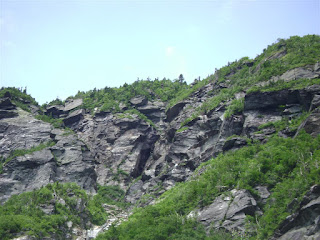
Can you see the face? Many people visit the Notch to view the rock formations. Even our youngest guests have no problems discovering fantastic creatures in the towering cliffs above. The dual mile long thousand foot cliffs which line Smugglers’ Notch are richly decorated with famous formations and provide ample opportunity to find new ones on your own. An imaginative person can discover new formations in the cliffs at the Notch just as someone gazing in the sky can make out different formations with the clouds. Some of the rock formations found in the Notch take a bit more imagination to piece together, but a few well known and more obvious formations in the Notch are: Smugglers’ Face, Elephants Head, Hunter and his Dog, The Shark’s Tooth, and The Singing Bird. The beautiful scenery sweeps up those who wonder into the Notch and gives them an unforgettable adventure full of cliffs, wildlife, and the undiscovered formations of rock. If you’re willing to explore you should come visit and try to spot the formations yourself. If your wondering eye leads to the discovery of new formations in the cliffs above, we would love to see them, let us know by stopping at the Information Booth or sending us a picture. Our Interpreter, JP, can also help you assist you in locating the harder formations.

If you need help finding The Smuggler’s Face in the above photo, click “Read More” to take a peak…


Friday, June 26, 2009

June at Seyon Lodge State Park

As spring turns toward summer, Seyon Lodge has seen a variety of guests, weather, wildlife and cuisine. During the last weekend of May, deep into the green drake hatch, the weather became finicky. Sunday morning brought rain showers, and then it cleared with temperatures in the sunshine reaching over 60 degrees. Suddenly wind gusts of 50 mpg drastically decreased the temperature The subsequent precipitation fell in the form of snow. By the end of the evening, temperatures dropped into the high twenties.

During a recent civil union, a dragonfly hatch blessed the party with its amazing transformation. Dragonflies are not the least of the wildlife sightings at Seyon Lodge State Park.

Square-tail brook trout, garter snakes, beaver, white-tailed deer, frogs, toads, mink, woodcock, flickers, robins, great blue heron and ruby-throated hummingbirds are among some of the animals that have been spotted in the park. The flora is also taking off as summer approaches. All the leaves on the trees have created an emerald canopy, which is like a green tunnel when driving up Seyon Pond Road. Fiddleheads are done and gone, but morel mushrooms are another culinary gift from the forest.

Along with procuring morels for us, guests brought a striped bass fresh from the coast of Massachusetts. What a treat! Guests have loved the home-made lasagna with bechamel sauce. This weekend, the potato-crusted salmon was a big hit along with the profiteroles filled with home-made coffee ice cream and chocolate sauce. The menu is dynamic and fresh to match the seasons and the atmosphere of the Green Mountains.

Nate Kargman is the Assistant Ranger at Seyon Lodge State Park

Thursday, June 18, 2009

Rain Gear: There is No Such Thing as Bad Weather, Just Inappropriate Clothing


Rain gear. What’s right for you?

Well, you’ve finally made it. You took the week off, collected all of your camping gear, and found the perfect tent site (or maybe a lean-to if your plans include one of Vermont’s spectacular State Parks.) The fire is crackling softly and then you hear the disconcerting roll of thunder in the distance. What to do? What to wear?

Rubberized rain gear has been around for a very long time. Soldiers in the American Civil War were issued rubber ponchos to wear in the inclement weather. It kept the water off of them (as it does now) but the design and construction was uncomfortable and not very functional under battle conditions.

The modern camper has a large variety of rain gear to choose from in the 21st century. There are rain suits made from thin plastic, treated rubber and nylon, Gore-Tex coats and pants, and just about everything in between. Heck, I have personally used a garbage bag with hole in it once or twice in my lifetime because I forgot to pack a rain jacket.

To help make an informed decision of which material to use or where to go shopping you need to take into account the details of your trip, the expected conditions, availability of products, and cost. Rain gear can run from pennies a bag to several hundred dollars, all dependant on just a few of the details above.

Rubber v. Gore-Tex.
We all learned in school that rubber repels water. Case-in-point: The tires of your car are in constant contact with water yet we depend on the construction to guide our vehicles safely down the road. Since the plastic boom of the fifties, sixties, and seventies, they have loads of plastic/rubber treated products sold as rain gear. The theory is that the density of plastic or rubber is greater than that of water, thereby creating a barrier. It works. It works very well. However the density also prohibits the moisture emanating from your body to escape. The sweat and perspiration gets trapped inside while the garment is repelling water outside. The inability of naturally occurring water vapor to evaporate after leaving your skin also creates a heat barrier than can speed dehydration. (Funny thing thinking about hydration during a rain storm, isn't it?)

Given all of these details one may ask “why buy this stuff?” Well, there are several reasons as to why you might. First and foremost is cost. You can get a reasonably comfortable rain suit for around $25.00. You can get an emergency poncho for a buck at just about any camping store. Cost may be your factor and if you are not planning on wearing the outfit or poncho for extended periods of time or doing strenuous exercise, it may just be a perfect match.

A plastic or rubberized poncho or jacket would work very well for the afternoon rain shower around the campground when you do not have a whole lot on your “to do list.” If you are not engaged in activities that may produce amounts of sweat and you can take the coat off in a reasonable amount of time, then why not?

Gore-Tex is an amazing treatment to cloth apparel. Gore-Tex is not the material itself so it can be applied to just about anything. You can see advertisements for Gore-Tex jackets, hats, pants, gloves… the list goes on. What Gore-Tex does is embed a barrier tightly compacted enough so rain water does not enter, yet loose enough for water vapor to escape. There is a much more technical explanation but that’s the short and simple story.

The military used Gore-Tex in some of their uniforms to keep our service men and women dry in the field. I had one of these jackets and loved it. Functional and durable in a summer rain or a winter snow, now if only I could remember what I did with it I’d be a happy guy.
The down side to Gore-Tex is that after a while, sometimes a very long while, the treatment breaks down and it loses its effectiveness. Also, you won’t leave the store for under about $150.00 for a basic covering.

On the positive side, since the material is allowed to breathe you run less of a chance of overheating or dehydration. Rain gear made with Gore-Tex is great for hiking and other physical activities in the wet and wild.

So before you pick the jacket or suit for you, look at the pros and cons. Are you going to be active? What is the time required that you may be wearing the gear? How much are you willing to spend? When you look at these issues honestly the choice gets easier to make.
As for me, I wish I could find that jacket but if I don’t and it’s a hot summer rainstorm, I just may go without all together!

Jim Fuller is the Park Ranger at Grand Isle State Park


Saturday, June 6, 2009

Check Out the Parks’ lets you borrow a day outside

Parks, libraries partner to get Vermonters outdoors this summer

Under "Check Out the Parks", each public library will get a one day pass that can be checked out for free admission to a state park. The passes are good at any of the state’s day-use parks and admit up to eight people traveling together in the same vehicle. Each library will determine the how long each pass may be checked out. Some libraries are choosing to purchase additional passes.
“Vermont State Parks are a perfect affordable getaway for families and friends,” the Governor said. “There’s a state park with something for everyone within a half-hour of every community. By checking out a park pass at their local library, folks can enjoy the best Vermont has to offer – our magnificent outdoors.”

“Check Out the Parks” partners people with favorite places, the Governor added.

“Libraries unlock the greater world through books, magazines, newspapers, audio-visual resources, the Internet and now the great outdoors and the many adventures of our park system,” the Governor said. “With this new partnership we’re expanding our No Child Left Inside initiatives and more Vermonters will be able to explore all we have to offer inside and outside.”

The passes are good from Memorial Day to Labor Day – the best time to enjoy the parks, said Jason Gibbs, commissioner of Forests, Parks and Recreation.

“Spring is in the air and we’re getting ready to welcome Vermonters and visitors alike to our state parks and all that they have to offer,” Gibbs said. “There’s something for everyone here. Hiking, camping, biking, swimming, fishing, paddling and more – and don’t forget the line-up of entertainment all summer long.”

Libraries have always kept pace with the times, said State Librarian Martha Reid.

“We’ve answered the call of the video and digital age – and now, more than ever, it’s important for families to have access to learning opportunities and healthy activities in the outdoors,” said Reid. “We’ve stayed meaningful to Vermonters by expanding our services and offerings. We want people to learn and explore, so ‘Check Out the Parks’ is exciting to our mission.”

Park passes will be available by May 25 at any of the 182 public libraries around Vermont.